46468605&ev=PageView&noscript=1" />
Content based on the Bible
© 2026 Après l’Enlèvement – All Rights Reserved
ABOUT
Après Enlèvement explores biblical prophecy, the Rapture of the Church, the End Times, and the Christian faith.
Discover what the Bible teaches about the return of Jesus Christ and how to be ready for it.
FOLLOW US
© 2026 Après l’Enlèvement – All Rights Reserved
ABOUT
Après Enlèvement explores biblical prophecy, the Rapture of the Church, the End Times, and the Christian faith.
Discover what the Bible teaches about the return of Jesus Christ and how to be ready for it.
FOLLOW US
📖 UNDERSTAND THE BIBLE
« And I saw when the Lamb opened one of the seals, and I heard, as it were the noise of thunder, one of the four beasts saying, Come and see. »
In this passage, John sees Jesus Christ, the Lamb of God, open the first of the seven seals of the sealed scroll. This event marks the beginning of the judgments of the Tribulation. Only Jesus Christ is worthy to open the seals and carry out God’s prophetic plan for the last days.
The opening of the first seal takes place after the Rapture of the Church. It introduces the first judgment of the Tribulation with the appearance of the rider on the white horse, symbolizing the beginning of the Antichrist’s worldwide rule. From this point onward, God’s judgments unfold until the glorious return of Jesus Christ.
This verse reminds us that Jesus Christ is sovereign over all history. The events of the Tribulation are not random, but the fulfillment of God’s perfect plan. Each seal that is opened brings the world one step closer to the return of Jesus Christ, the defeat of evil, and the establishment of His Millennial Kingdom.
« Seventy weeks are determined upon thy people and upon thy holy city, to finish the transgression, and to make an end of sins, and to make reconciliation for iniquity, and to bring in everlasting righteousness, and to seal up the vision and prophecy, and to anoint the most Holy. »
In this passage, the angel Gabriel reveals to Daniel God’s prophetic plan for Israel and Jerusalem. The seventy weeks represent a period of 490 prophetic years that God has appointed to accomplish His purposes for His people.
The first sixty-nine weeks lead to the coming of the Messiah, while the seventieth week corresponds to the seven-year Tribulation. This final period will bring about the fulfillment of the last prophetic events before the glorious return of Jesus Christ.
This verse outlines God’s purposes for this prophetic timeline: to bring an end to transgression, to deal with sin, to provide atonement for iniquity, to establish everlasting righteousness, to fulfill every prophecy, and to prepare for the reign of the Messiah. These purposes will reach their complete fulfillment when Jesus Christ returns to establish His Millennial Kingdom.
This passage is one of the most important prophecies in the Old Testament. It demonstrates that God is sovereign over history and that He will faithfully fulfill every promise He has made to Israel and to the world.
« And I saw heaven opened, and behold a white horse; and he that sat upon him was called Faithful and True, and in righteousness he doth judge and make war. »
In this passage, John describes the glorious return of Jesus Christ at the end of the Tribulation. Heaven is opened, and Jesus Christ appears riding on a white horse, a symbol of victory, glory, and triumph. Unlike the rider of the first seal in Revelation 6, who represents the Antichrist, this rider is the true King and the true Messiah.
The titles “Faithful and True” emphasize that Jesus Christ perfectly fulfills all of God’s promises and judges with perfect righteousness. His return marks the end of the Antichrist’s reign and the rebellion of the nations against God.
This verse announces the decisive intervention of Jesus Christ at the battle of Armageddon. He comes to defeat His enemies, establish righteousness on the earth, and inaugurate His Millennial Kingdom, fulfilling the prophecies recorded in the Scriptures.
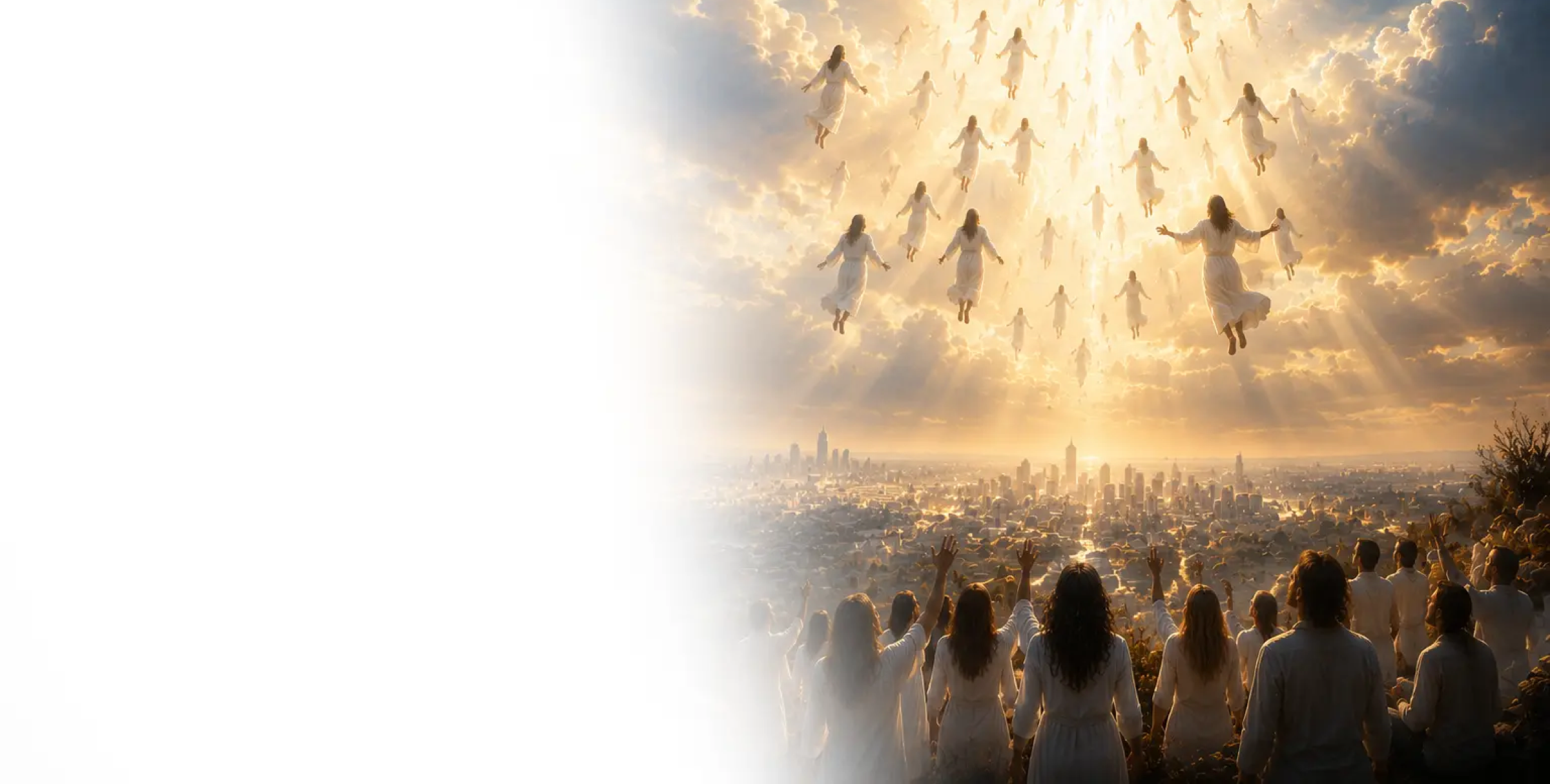
16 For the Lord himself shall descend from heaven with a shout, with the voice of the archangel, and with the trump of God: and the dead in Christ shall rise first:
17 Then we which are alive and remain shall be caught up together with them in the clouds, to meet the Lord in the air: and so shall we ever be with the Lord.
In this passage, Paul clearly describes the Rapture of the Church. Jesus Christ will descend from heaven, the dead in Christ shall rise first, and then those who belong to Christ and are part of His Church who are still alive will be caught up with them to meet the Lord in the air. The Church is the Bride of Christ: she belongs to Him and will be united with her Bridegroom at the Rapture.
This event will take place before the beginning of the seven-year Tribulation. Jesus Christ will meet His Church in the air and take her to Himself. It is important to clarify that not all believers will be raptured: the Rapture concerns those who belong to Christ and are part of His Church. After the Rapture, other people will still be able to believe in Jesus Christ during the Tribulation, but they will not become part of the Church, because the Church will already have been raptured. The Church Age will therefore come to an end at the Rapture, after which God will continue His prophetic plan concerning Israel and the nations.
This passage is one of the clearest promises concerning the Rapture of the Church. It gives a special hope to those who belong to Christ and are part of His Church: they will be reunited with those who have been raised and will be with the Lord forever.
The Church as the Bride of Christ
In the Bible, the Church is presented as the Bride of Christ. This image draws on the marriage customs of biblical times and helps explain why the Rapture is presented as the moment when Christ comes to take His Bride to Himself.
The Marriage Picture in the Bible
In the marriage customs of ancient Israel, the father of the bridegroom had an important role in the marriage arrangement. After the engagement, the bridegroom would leave to prepare a place for his future bride.
He would later return at the appointed time to take her to himself. The bride therefore had to remain ready and wait for the bridegroom’s arrival. This imagery helps us understand the words of Jesus:
“I will come again, and receive you unto myself; that where I am, there ye may be also.” — John 14:3
Jesus is the Bridegroom, and the Church is His Bride. It is therefore significant that He says He will return to receive His Bride to Himself.
The Role of the Father
Jesus also spoke about the exact timing of His coming:
“But of that day and hour knoweth no man, no, not the angels of heaven, but my Father only.” — Matthew 24:36
Within the marriage imagery, this corresponds to the traditional role of the father in determining when the son would go to receive his bride. The Son knew that He would return, but the exact timing was in the Father’s hands.
However, an important distinction should be made: the Bible does not explicitly state that Christian marriage reproduces every detail of an ancient Jewish wedding ceremony. Rather, these similarities help us understand the biblical imagery surrounding Christ and His Church.
Why This Concerns the Church
This picture also explains why it is important not to simply use the expression “all believers” when speaking about the Rapture.
The Church is the Bride of Christ. Jesus will come to take His Bride so that she may be with Him. People who turn to Jesus Christ during the Tribulation can still be saved, but they will not become part of the Church that has already been raptured.
The Rapture can therefore be understood as the moment when the Bridegroom comes to receive His Bride. The Church Age then comes to an end, while God continues His prophetic plan concerning Israel and the nations.
This also gives special meaning to Revelation 19:7:
“Let us be glad and rejoice, and give honour to him: for the marriage of the Lamb is come, and his wife hath made herself ready.”
The picture is therefore consistent: Christ is the Bridegroom, the Church is His Bride, the Rapture is the gathering of the Bride to her Bridegroom, and the marriage of the Lamb follows.