Content based on the Bible
© 2026 Après l’Enlèvement – All Rights Reserved
ABOUT
Après Enlèvement explores biblical prophecy, the Rapture of the Church, the End Times, and the Christian faith.
Discover what the Bible teaches about the return of Jesus Christ and how to be ready for it.
FOLLOW US
© 2026 Après l’Enlèvement – All Rights Reserved
ABOUT
Après Enlèvement explores biblical prophecy, the Rapture of the Church, the End Times, and the Christian faith.
Discover what the Bible teaches about the return of Jesus Christ and how to be ready for it.
FOLLOW US
📖 UNDERSTAND THE BIBLE
1 And I saw in the right hand of him that sat on the throne a book written within and on the backside, sealed with seven seals.
2 And I saw a strong angel proclaiming with a loud voice, Who is worthy to open the book, and to loose the seals thereof?
3 And no man in heaven, nor in earth,
neither under the earth, was able to open the book, neither to look thereon.
4 And I wept much, because no man was found worthy to open and to read the book, neither to look thereon.
In this passage, John sees God seated on the throne holding a book sealed with seven seals in His right hand. This book represents God’s plan concerning the judgment and the fulfillment of His purposes for the earth. The seven seals show that its contents are perfectly secured and that no created being has the authority to open it.
A powerful angel announces that someone must be found worthy to open the book and break its seals. However, no one in heaven, on earth, or under the earth is found worthy. John begins to weep because the opening of the book is necessary for God’s plan to be carried out.
This scene reveals that no creature has the ability or the merit to accomplish God’s plan by its own power. Only Jesus, the Lamb of God, will be found worthy to open the book because He has conquered sin and redeemed humanity through His sacrifice.
This scene prepares for the appearance of the Lamb in the following verses and the beginning of the judgments revealed in the book of Revelation.
5 And one of the elders saith unto me, Weep not: behold, the Lion of the tribe of Juda, the Root of David, hath prevailed to open the book, and to loose the seven seals thereof.
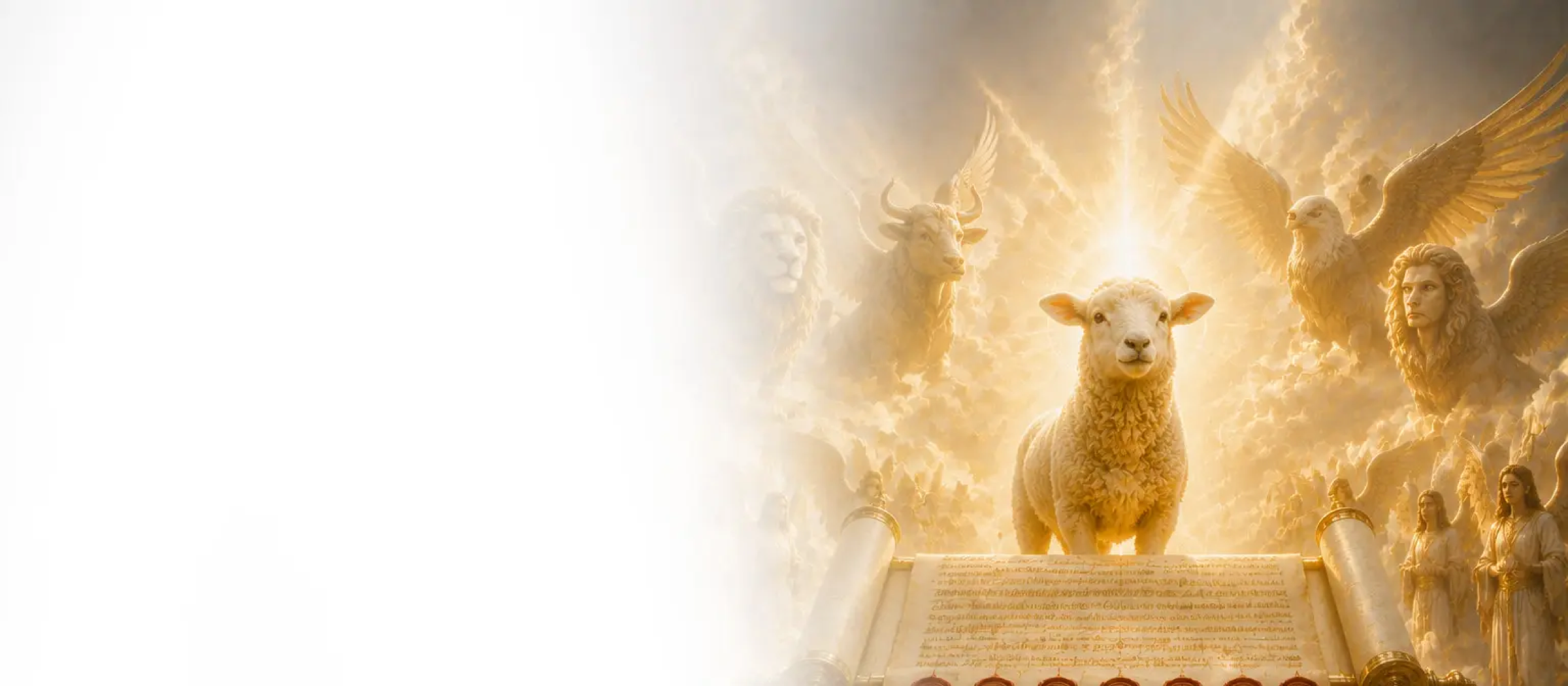
6 And I beheld, and, lo, in the midst of the throne and of the four beasts, and in the midst of the elders, stood a Lamb as it had been slain, having seven horns and seven eyes, which are the seven Spirits of God sent forth into all the earth.
7 And he came and took the book out of the right hand of him that sat upon the throne.
8 And when he had taken the book, the four beasts and four and twenty elders fell down before the Lamb, having every one of them harps, and golden vials full of odours, which are the prayers of saints.
9 And they sung a new song, saying, Thou art worthy to take the book, and to open the seals thereof: for thou wast slain, and hast redeemed us to God by thy blood out of every kindred, and tongue, and people, and nation;
10 And hast made us unto our God kings and priests: and we shall reign on the earth.
In this passage, John sees Jesus appear as the Lamb of God, the One worthy to open the sealed book with seven seals. He is presented through two complementary images: the Lion of the tribe of Judah, representing His victory and royal authority, and the Lamb that was slain, reminding us of His sacrifice for the salvation of humanity.
The Lamb receives the book from the hand of God, showing that Jesus alone has the authority to accomplish God’s plan concerning the judgments and the final restoration of creation. The seven horns and seven eyes symbolize His perfect power and the fullness of the Spirit of God.
The living creatures and the twenty-four elders worship the Lamb because He redeemed people from every tribe, tongue, people, and nation by His blood. This scene reveals that Jesus’ sacrifice opens the way of salvation to the nations and establishes those who belong to Him as a kingdom and priests unto God.
This passage shows that Jesus is both the Savior who sacrificed Himself for humanity and the victorious King who receives the authority to carry out judgment and reign over the earth.
11 And I beheld, and I heard the voice of many angels round about the throne and the beasts and the elders: and the number of them was ten thousand times ten thousand, and thousands of thousands;
12 Saying with a loud voice, Worthy is the Lamb that was slain to receive power, and riches, and wisdom, and strength, and honour, and glory, and blessing.
13 And every creature which is in heaven and on the earth, and under the earth, and such as are in the sea, and all that are in them, heard I saying, Blessing, and honour, and glory, and power, be unto him that sitteth upon the throne, and unto the Lamb for ever and ever.
14 And the four beasts said, Amen. And the four and twenty elders fell down and worshipped him.
In this passage, John witnesses an immense scene of worship in heaven. Thousands upon thousands of angels surround the throne of God, the four living creatures, and the twenty-four elders, proclaiming the worthiness of the Lamb, Jesus.
The Lamb is declared worthy to receive power, riches, wisdom, strength, honour, glory, and blessing because He was slain and accomplished the work of redemption. His sacrifice gives Him the authority to open the sealed book and carry out God's plan.
All creation then joins in this worship, recognizing the One who sits upon the throne and the Lamb. This universal praise reveals the honor given to Jesus alongside God and His eternal authority.
This scene shows that Jesus, the sacrificed Lamb and victorious King, is at the center of God's plan. Before the seals are opened and the judgments of Revelation unfold, heaven already proclaims His victory and eternal sovereignty.
« And I saw when the Lamb opened one of the seals, and I heard, as it were the noise of thunder, one of the four beasts saying, Come and see. »
In this passage, John sees Jesus Christ, the Lamb of God, open the first of the seven seals of the sealed scroll. This event marks the beginning of the judgments of the Tribulation. Only Jesus Christ is worthy to open the seals and carry out God’s prophetic plan for the last days.
The opening of the first seal takes place after the Rapture of the Church. It introduces the first judgment of the Tribulation with the appearance of the rider on the white horse, symbolizing the beginning of the Antichrist’s worldwide rule. From this point onward, God’s judgments unfold until the glorious return of Jesus Christ.
This verse reminds us that Jesus Christ is sovereign over all history. The events of the Tribulation are not random, but the fulfillment of God’s perfect plan. Each seal that is opened brings the world one step closer to the return of Jesus Christ, the defeat of evil, and the establishment of His Millennial Kingdom.